
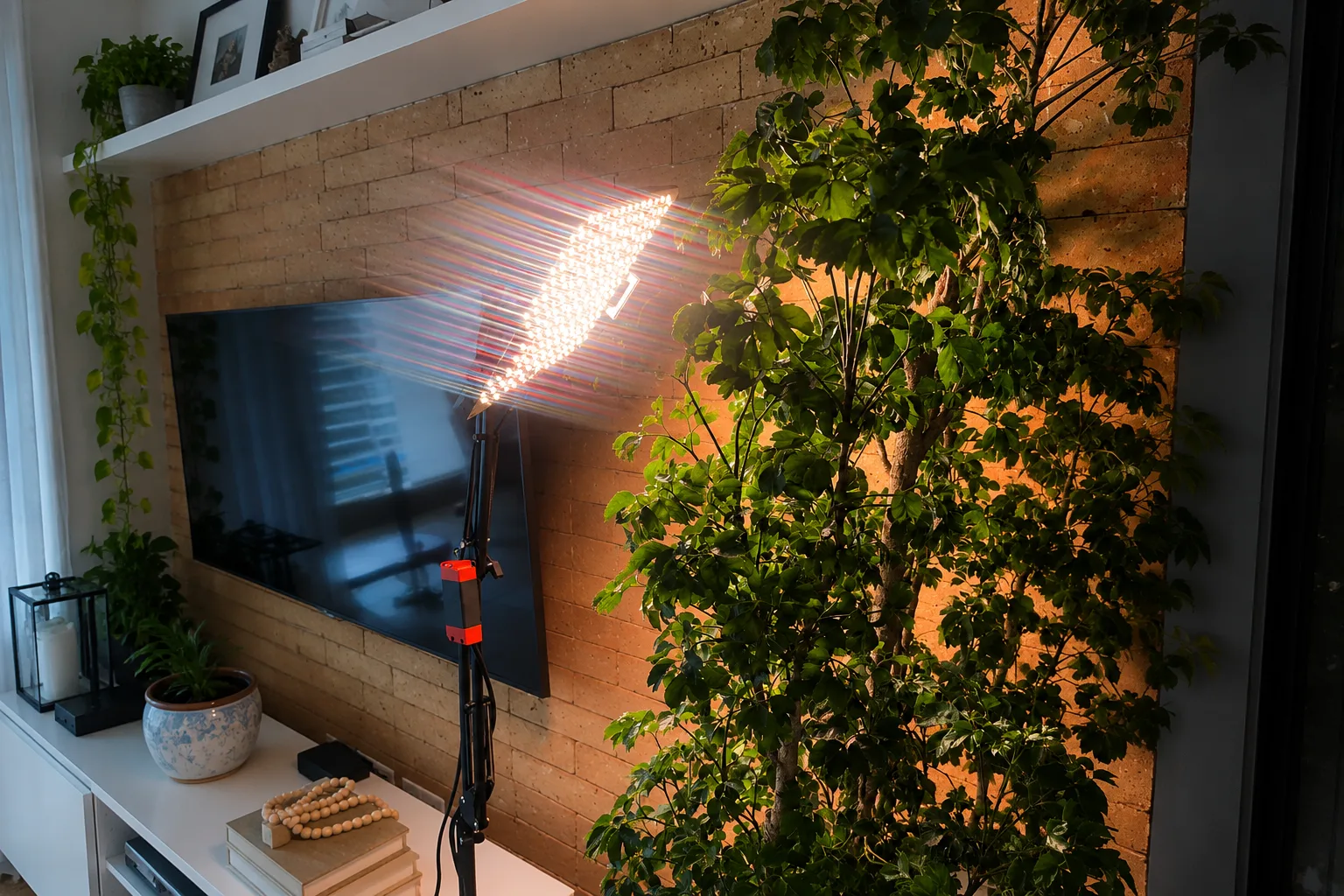
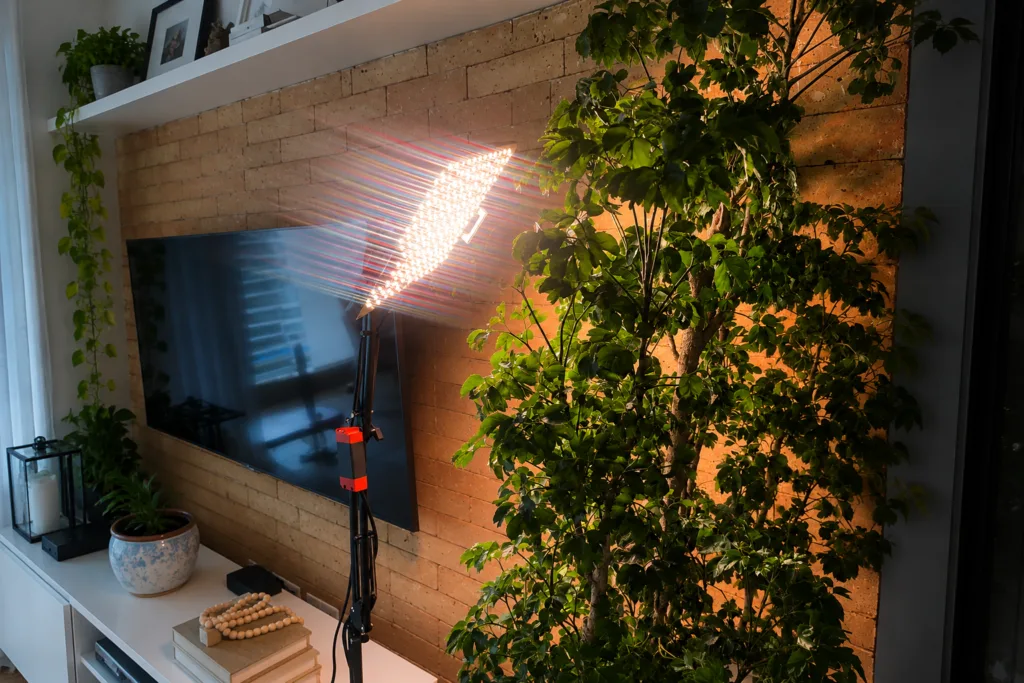
When I outgrew my single windowsill and moved a chunk of my collection to a metal shelving unit in a spare corner with almost no natural light, I assumed I could just get one grow light and hang it somewhere in the middle. That assumption cost me about six weeks of stretched, pale growth on the bottom two shelves before I actually sat down and figured out what I was doing wrong. This is what I learned setting up plant grow lights for an actual multi-shelf setup, not just a single plant on a desk — the part that trips up a lot of people once they scale past one pot.
The Mistake That Started This Whole Process
My original setup was a single full-spectrum panel clipped to the top of the shelving unit, angled down, meant to light all four tiers at once. It worked fine for the top shelf. The second shelf got noticeably weaker light, and by the bottom two shelves, my pothos and a snake plant were stretching sideways trying to find more light, with new leaves coming in smaller and more spaced out than the older growth.
The fix wasn’t a stronger single light — it was accepting that each shelf basically needed its own light source, mounted underneath the shelf above it rather than relying on one fixture to flood the whole unit from the top. Once I put a separate strip light under each of the top three shelves, angled down onto the shelf below, the difference within a month was obvious. New growth on the bottom shelf finally came in compact and full-colored instead of stretched and pale.
Why “Full Spectrum” Actually Matters Here
Before this setup, I honestly thought full spectrum was mostly a marketing term. What changed my mind was noticing how differently my plants responded once I compared a full-spectrum strip against an old blue-heavy panel I’d been using temporarily on one shelf during the transition. The plants under the blue-heavy light developed noticeably tighter, almost compact growth, but the leaf color looked slightly washed out compared to the ones under full spectrum, which included more of the red and white wavelengths closer to natural daylight.
For leafy plants like pothos and philodendron, this difference is fairly subtle. For anything I wanted to actually flower — I keep a couple of African violets on the second shelf — the difference was not subtle at all. Under the blue-heavy light, they stayed leafy and never bloomed for almost two months. Within a few weeks of switching to a full-spectrum light with a stronger red component, I had my first flowers.
The Timer Feature I Almost Skipped
I’ll admit I thought a timer was an unnecessary extra cost when I bought my first light — I figured I’d just remember to turn it off each night. I lasted about four days before I forgot twice in a row, and one of those nights the light stayed on well past 2 AM. Nothing looked dramatically wrong immediately, but over the following weeks I noticed slower, weaker growth across the shelf compared to before, which lines up with what I’ve since read about plants needing a genuine dark period to process the energy they’ve absorbed during the day, not just light.
Once I put every light on its own $12 mechanical outlet timer, set to 14 hours on and 10 hours off, growth across all four shelves evened out within about a month. The timer turned out to be less about convenience and more about actually giving the plants what they needed on a schedule I couldn’t reliably manage by hand.
Matching Light Intensity to Each Shelf’s Plants
Not every shelf gets the same treatment in my setup, and figuring this out took some trial and error. The top shelf, which holds a couple of succulents that want more intense light, has its strip mounted closer, around 8-10 inches above the plants. The lower shelves, mostly leafy houseplants like pothos and a peace lily, have their lights mounted further back, closer to 14-16 inches, since they scorched slightly the first time I mounted a light too close, showing crispy brown patches on the leaves nearest the fixture within about a week.
I learned to watch the plants rather than trust a single fixed distance for everything. If new leaves come in smaller than the older ones, the light’s probably too far or too weak. If I see bleached or crispy patches specifically on the side facing the light, it’s too close. Adjusting based on what the plant is actually showing me has worked far better than following a generic distance recommendation from a product listing.
Comparing What I’ve Actually Used
I’ve cycled through three different types of grow lights across this shelving project, and each had a clear role:
A clip-on single-bulb light worked fine for one plant on my original windowsill setup, but was hopeless trying to cover an entire shelf evenly — I’d get one bright spot and the rest of the shelf in comparative shadow.
A full panel mounted above the whole unit gave decent light to the top shelf but, as I mentioned, left the lower shelves underlit. It’s a better fit for a single, wide, open growing area rather than a stacked shelf setup like mine.
Individual strip lights per shelf ended up being the actual solution. More lights to manage and more timers to set, but it’s the only approach that gave every shelf consistent, appropriate light rather than fighting over one fixture trying to do too much.
Signs I Watch for Now
A few indicators I check regularly across the whole shelf, based on problems I’ve actually run into:
- Leggy, stretched stems reaching toward one side — usually means the light on that shelf is too weak or too far away, not that the plant needs more water or fertilizer, which was my first (wrong) guess the first time I saw it.
- Small, pale new leaves compared to older growth — a light intensity problem, in my experience, even when the light is technically running the correct number of hours.
- Crispy or bleached patches facing the light source — too close, especially common on the shelf where I mount lights closer for the succulents.
- No flowering on plants that should bloom — for my African violets, this traced directly back to a spectrum issue, not a watering or fertilizer issue, which took me embarrassingly long to figure out.
What I’d Set Up Differently From Day One
If I were starting this shelving project over, I’d skip the single top-mounted panel entirely and go straight to individual lights per shelf with timers from the very beginning. I’d also group plants by light needs on the same shelf rather than mixing a succulent with a peace lily and trying to find a compromise distance that didn’t quite work for either one. The biggest lesson from the whole process has been that plant grow lights aren’t a “set it and forget it” purchase — the setup needs to match the actual plants and actual space, not just be the strongest or most expensive option available.
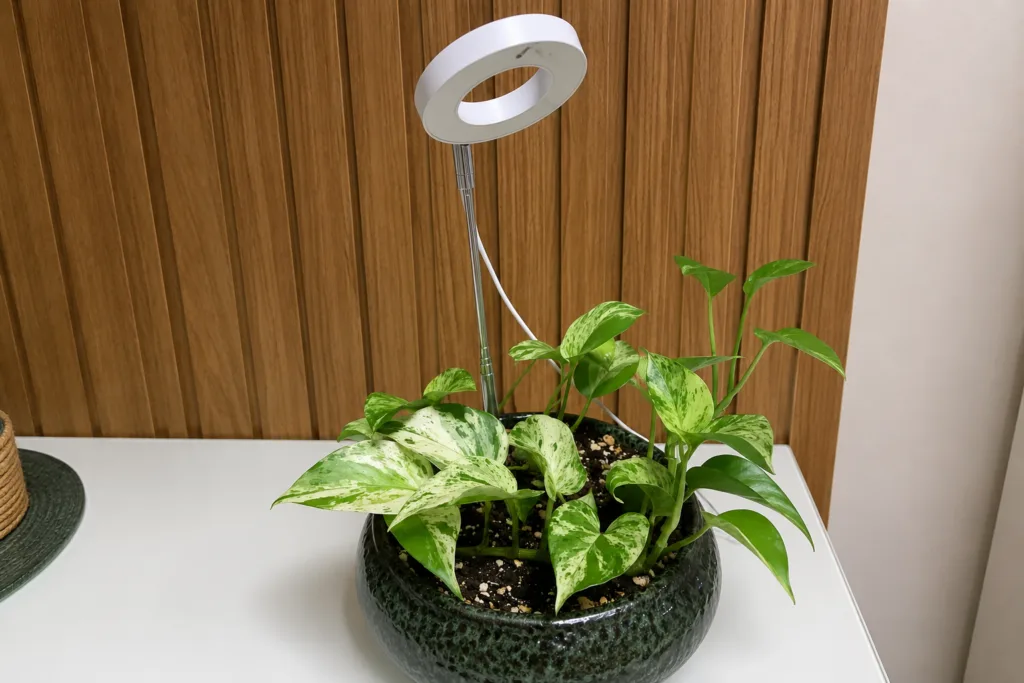
Frequently Asked Questions
How many hours a day should plant grow lights run? In my experience, 12-16 hours has worked well across most of my houseplants, with 14 hours being what I’ve settled on and kept consistent using a timer.
Do all my plants need the same grow light setup? No — in my shelf setup, succulents wanted a closer, more intense light, while leafy houseplants needed more distance to avoid scorching. Grouping plants with similar light needs on the same shelf made this much easier to manage.
Is a timer really necessary for plant grow lights? Based on my own results, yes. Growth noticeably evened out and improved once I put every light on a consistent 14-hours-on, 10-hours-off schedule instead of manually turning lights on and off.
Can one grow light cover multiple shelves? Not effectively, in my experience. A single fixture mounted above a multi-tier shelving unit left my lower shelves underlit — individual lights per shelf gave far more even results.

Gardening Writer & Plant Enthusiast
Sarah Mitchell is a passionate gardening writer dedicated to helping people bring more nature into their homes. She loves exploring indoor plants, flowers, and sustainable gardening practices, sharing simple and practical tips that make plant care easier for everyone.