
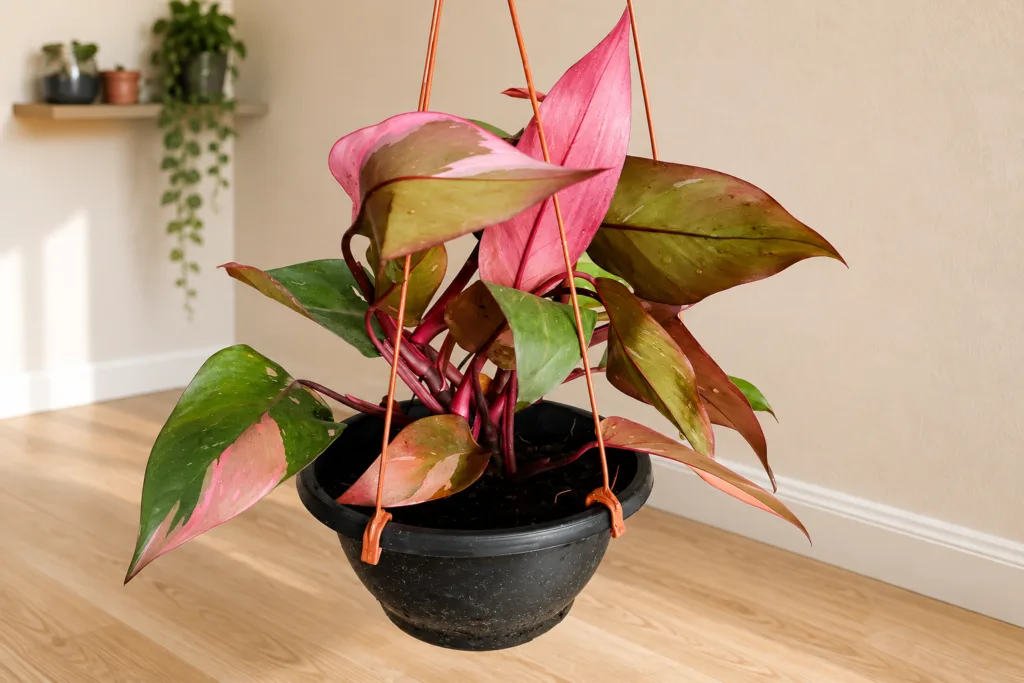
My heartleaf philodendron and my pink princess sit about three feet apart on the same shelf, and for the first several months I treated them almost identically, assuming that because they’re both philodendrons, they’d respond the same way to the same care. The heartleaf did fine. The pink princess slowly lost most of its pink variegation, coming in nearly all green on new growth, which is when I realized these two plants, despite sharing a genus, actually needed meaningfully different treatment from me.
Here’s what real philodendron care has looked like for me, split between the plant that’s been genuinely low-maintenance and the one that’s demanded more attention to get right.
The Heartleaf: About as Easy as Care Gets
My heartleaf philodendron has been remarkably forgiving through almost every mistake I’ve made with it. I let the top inch or two of soil dry out before watering, roughly every 7-10 days depending on the season, and it’s tolerated stretches where I’ve gone closer to two weeks without any real complaint beyond slightly less perky leaves that bounced back within a day of watering.
Light has been similarly forgiving. It’s spent time in a spot with fairly low, indirect light and continued growing, just more slowly and with slightly smaller leaves than when I moved it to a brighter spot later on. The vining stems have needed occasional pruning to keep from getting too leggy and sparse, which I do a few times during the growing season, using the trimmings to propagate new plants, since cuttings from this variety have rooted in water for me reliably within about 3-4 weeks nearly every time.
The Pink Princess: Where Light Actually Determines the Plant’s Whole Personality
My pink princess taught me that “bright indirect light” as a general philodendron guideline doesn’t capture how specifically this variety depends on light for its defining feature. The pink and green variegated pattern isn’t just decorative — it directly reflects how much light the plant is getting, and I learned this the hard way after keeping it in the same moderate light spot as my heartleaf for a few months.
New leaves during that period came in with noticeably less pink, mostly solid dark green with just a hint of color at the edges, compared to the vibrant pink-and-green splash I remembered from when I bought it. Moving it to a spot with meaningfully brighter indirect light, closer to a window than my heartleaf sits, brought the pink variegation back within a couple of new leaves, typically over about two months.
I’ve also learned that too much direct sun does the opposite kind of damage — a brief stretch near a window that got some direct afternoon light caused a couple of the palest, most heavily variegated sections of leaf to develop scorched, crispy patches, since the white and pink portions of the leaf seem to be more vulnerable to sun damage than the solid green parts, similar to what I’ve noticed with other variegated plants in my collection.
Watering the Pink Princess Required More Attention Than I Expected
Beyond light, I’ve found the pink princess somewhat less forgiving of watering inconsistency than my heartleaf. A period of underwatering caused visible leaf curling and a slightly duller look to the coloring faster than I’ve seen on my heartleaf under similar conditions, and an overwatering scare, from a stretch of watering too frequently during a rainy week when I misjudged how quickly the soil was actually drying, caused a couple of lower leaves to yellow and soften within about a week. I’ve since started checking the soil specifically for this plant rather than assuming it needs the same schedule as my more tolerant heartleaf.
Propagating Each Variety
Propagating my heartleaf has been genuinely simple — stem cuttings with at least one node root in water within a few weeks nearly every time, and I’ve given away probably a dozen small plants grown this way at this point. Propagating the pink princess has been a bit more nerve-wracking, mostly because I’ve read that a cutting with too little variegation on its own can revert to solid green over time, so I’ve tried to choose cuttings that already show a good balance of pink and green rather than ones that happen to be mostly one color. My results have been mixed but generally positive — two out of three pink princess cuttings I’ve rooted have kept a reasonable amount of variegation as they’ve grown, while one came in almost entirely green despite my attempt to select a balanced cutting.
Repotting and Soil for Both
I use a well-draining mix with added perlite for both plants, and I repot roughly every 1-2 years or when I notice roots crowding the drainage holes. The pink princess has grown somewhat slower overall than the heartleaf in my experience, which has meant it’s needed repotting less frequently, roughly every other year compared to annually for the faster-growing heartleaf.
Common Issues I’ve Actually Dealt With
Yellowing leaves on the heartleaf — in my experience, this has almost always meant overwatering, resolved by letting the soil dry out more between waterings.
Loss of pink variegation on the pink princess — a light issue for me specifically, resolved by moving to a brighter, though still indirect, spot.
Scorched patches on the pink princess’s palest leaf sections — direct sun exposure, which seems to affect the lighter variegated portions of the leaf more severely than the solid green areas.
Leggy, sparse growth on the heartleaf — addressed with regular pruning during the growing season, which also doubles as an easy source of propagation cuttings.
Mealybugs — I’ve dealt with a mild infestation on the heartleaf once, tucked into leaf axils along the vining stem, cleared up over about two weeks with a cotton swab dipped in rubbing alcohol.
What I’d Tell Someone Choosing Between the Two
If you want a genuinely low-maintenance plant that tolerates inconsistency in watering and light, the heartleaf has earned that reputation in my experience. If you’re drawn to the pink princess specifically for its variegation, be prepared to actually prioritize bright indirect light as a non-negotiable rather than a nice-to-have, since in my direct comparison, that single factor made the difference between a plant that looked like its name and one that slowly turned into an ordinary green philodendron.

Frequently Asked Questions
Why is my pink princess philodendron losing its pink color? Based on my own experience, insufficient light was the cause. Moving mine to a brighter, indirect spot restored the variegation on new leaves within about two months.
Is heartleaf philodendron easier to care for than pink princess? In my direct comparison, yes — the heartleaf has tolerated more inconsistency in watering and light without visible stress, while the pink princess needed more specific attention to light to maintain its defining feature.
How do I propagate a philodendron without losing variegation? For pink princess specifically, I’ve had better results selecting cuttings that already show a good balance of pink and green, though even then, results have been somewhat unpredictable in my experience.
Why does my philodendron have yellow leaves? In my experience with the heartleaf specifically, this has consistently pointed to overwatering, resolved by letting the soil dry out more fully between waterings.

Gardening Writer & Plant Enthusiast
Sarah Mitchell is a passionate gardening writer dedicated to helping people bring more nature into their homes. She loves exploring indoor plants, flowers, and sustainable gardening practices, sharing simple and practical tips that make plant care easier for everyone.